

Drawdown Maths: The True Cost of Losses

Read Time: 3-4 minutes
Most traders can tell you their win rate. Fewer can tell you what a bad run actually costs them – and almost nobody works it out before the bad run arrives.
The problem is that gains and losses aren't symmetrical. Lose 10% and you need 11.1% to get back to even. That gap sounds trivial. It isn't, and it widens fast.
- The recovery table
- Why this happens
- What this means for position sizing
- Where traders get caught
- Three rules to follow
- The point
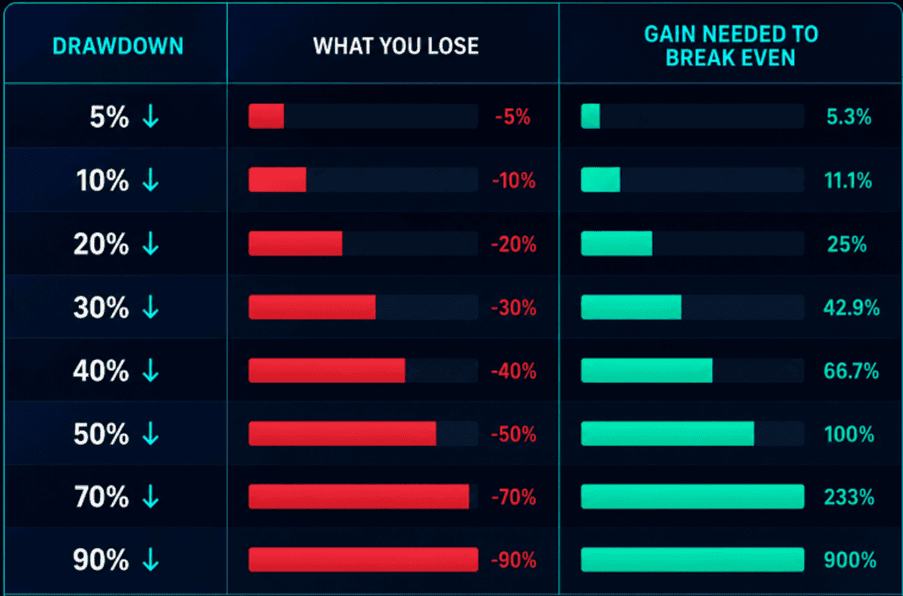
Table 1: Examples of gains required to cover different loss amounts.
The maths is simple enough.
If you lose a fraction (d) of your account, then the recovery required is d / (1 − d). For example;
Loss amount: 5% (0.05)
Gain needed to recover loss:
d / (1 − d)
0.05 / (1 – 0.05) = 0.053 or 5.3%
Losing half your capital doesn't mean you need half your capital back – it needs everything you have got left, doubled.
Sit with that last row for a moment. A trader down 90% must grow their remaining balance tenfold just to return to the starting line. That's not a rough patch – it’s a career!
After taking a loss, you are then compounding a smaller base. When your account drops from $10,000 to $5,000, every percentage point you earn afterwards is calculated on $5,000, not $10,000. For example, the 20% winner that used to be worth $2,000 is now worth $1,000.
Losses shrink the engine. Gains have to work harder with less.
Here's where it gets practical. Assume you risk a fixed percentage of your account on each trade and you hit a losing streak. Six losses in a row are uncomfortable but entirely normal – with a 50% win rate it happens roughly once every 64 sequences.
Here's where it gets practical. Assume you risk a fixed percentage of your account on each trade and you hit a losing streak. Six losses in a row are uncomfortable but entirely normal – with a 50% win rate it happens roughly once every 64 sequences.
At 1% risk per trade, six straight losses leaves you down about 5.9%. Annoying, because you now need 6.3% to recover, which is a few good trades.
At 5% risk, the same six losses places you down 26.5%. You now need a 36% gain to get back to even, and you're doing it with a quarter of your capital gone (not to mention your confidence will be somewhere near the floor!).
At 10% risk, you are now down 47% and staring at a 90% recovery.
Same strategy. Same six trades. Wildly different outcomes – determined entirely by a number you chose before the first trade was placed.
Risking more per trade increases your expected return in the short run, so it Risking more per trade increases your expected return in the short run, so it feels like the aggressive approach is working right up until it isn't. And the point at which it stops working isn't a gentle taper. Past a certain risk level, adding more size actually lowers your long-run return, because the drawdown maths eats away at compounding faster than the extra size adds to it.
There's also the behavioural cost, which no spreadsheet captures. Traders rarely execute their strategy properly at a 40% drawdown. They widen stops, chase, double down, or abandon a perfectly sound system three trades before it turns around. The maths says you need 67% to recover; human nature says you'll do something silly well before you get there.
1. Decide your maximum acceptable drawdown first, then work backwards. If you can't stomach more than 20%, you shouldn't be risking 5% a trade. Ten losses at 5% takes you to 40%.
2. Treat 1-2% per trade as a ceiling, not a starting point. It looks slow. It's the difference between recoverable and terminal.
3. Reduce size during a drawdown, not after it. Risking a fixed percentage does this automatically – as the account shrinks, so does the dollar risk. Fixed-lot traders don't get that protection and dig deeper with every loss.
Trading survival isn't really about finding better entries. It's about making sure that a normal, statistically unremarkable losing streak doesn't put you in a hole the maths won't let you climb out of.
Work out your recovery number before you need it. It's a five-minute exercise, and it's the cheapest risk management you'll ever do.
We’ll never share your email with third-parties. Opt-out anytime.