

Knowing When a Trade Is Wrong: A Guide to Invalidation

Read Time: 4-5 minutes
Every trade is a small prediction. Learning to recognise the exact moment that prediction has stopped working is one of the most valuable skills a new trader can build.
When you open a position, you're really making a quiet bet: the price is more likely to move one way than the other, and you're putting money behind that view.
But markets don't owe you anything, and predictions don't always come good. One of the hardest things a beginner has to learn is when to accept that an idea has stopped working – and to act on it rather than hope it turns around.
That moment has a name. It's called invalidation, and deciding where it sits before you click buy or sell is much of what separates a disciplined trader from someone clinging to a losing position.
- What invalidation actually means
- It isn't the same as a stop-loss
- Invalidation isn't always about price
- Write it down before you enter
Invalidation is the specific condition that proves your trade idea wrong. Not "the price moved against me a little" – markets are noisy, and some movement against you is completely normal. Invalidation is the line in the sand where the reason you entered no longer holds true – the price at which you’re willing to accept that your trade idea is wrong.
Let’s say you go long because the price keeps respecting a support level, bouncing off it again and again. Your thesis is simple: buyers keep stepping in here. If the price then closes firmly below that support, the reason you were in the trade has gone. The thing you were betting on didn't happen. That is invalidation.
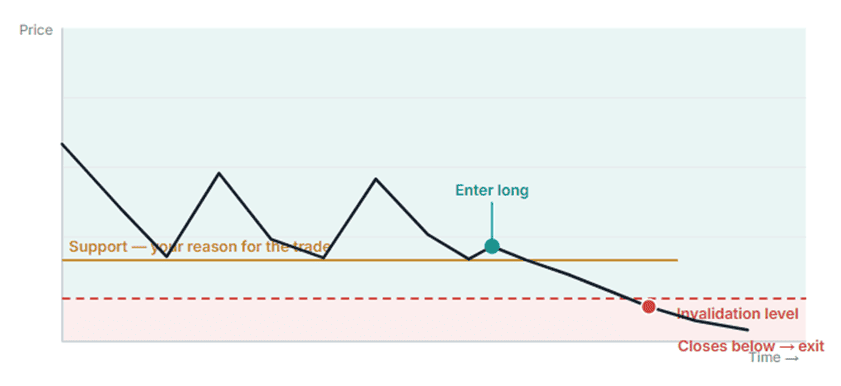
Chart 1 – The anatomy of an invalidation level. The trade is entered because support is holding. The moment price closes below the invalidation line, that reason is gone – and so is the case for staying in.
A stop-loss is the mechanic: the order that closes your position automatically. Invalidation is the thinking that tells you where that order belongs. The two often sit at the same price, but they come from different places.
Plenty of beginners set a stop based on money. For example; "I'm willing to lose $50, so I'll put my stop $50 away." The trouble is that the market has no idea what your $50 looks like. Price moves according to structure: support, resistance, swing highs and lows. It doesn't move according to your account balance. Place your stop at an arbitrary distance and ordinary market noise can knock you out of a trade that was never actually wrong.
A better approach is to find your invalidation level first, then size your position so the loss is acceptable if that level is reached. Structure decides the ‘where’, your risk tolerance decides the ‘how much’.
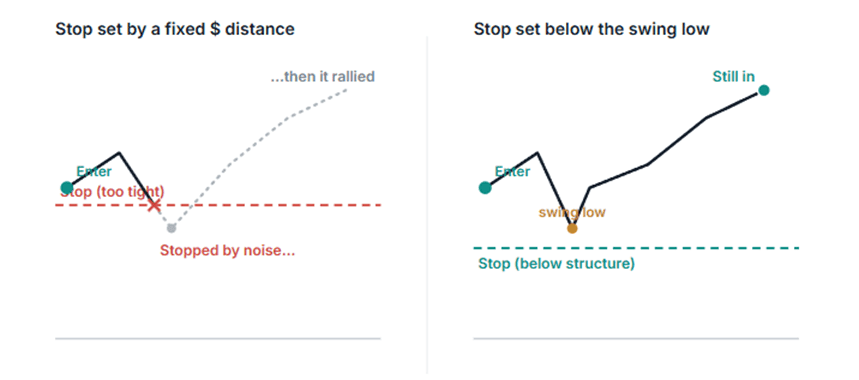
Chart 2 – Same price move, two stop placements. A stop set purely on dollars sits inside the noise and gets clipped before the idea plays out. A stop placed just below the structure absorbs the noise and only triggers if the level genuinely breaks.
Price is the most common trigger, but it isn't the only one. A trade idea can be invalidated in a few different ways, and recognising which applies to your trade keeps you honest once the position is live and emotions are running hot.
- By price: a key level breaks, as in the examples above.
- By condition: you entered expecting something specific – a data release to land a certain way, a breakout to hold – and that condition simply fails to play out.
- By time: sometimes a trade just doesn't do what you expected within the window you gave it. If your reason was momentum and the price drifts sideways for hours, the idea may have quietly expired even if your level hasn't broken.
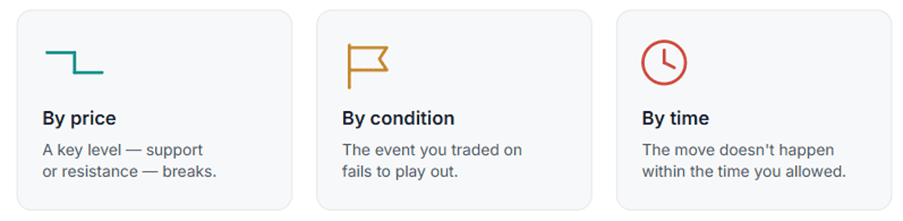
Chart 3 – Three ways a trade can be invalidated. Most traders only think about price, but a clear condition- or time-based exit can save you from sitting in a position that's already told you it's wrong.
The single most useful habit here is to define your invalidation in advance, while you're calm and objective. Once a trade is open and money is moving, it becomes very tempting to shift the goalposts – to widen your stop, to invent a fresh reason to stay in, to tell yourself it'll come back. That's how small, planned losses turn into large, unplanned ones.
Before you place a trade, try answering one question in plain words: what would have to happen for me to know I'm wrong? If you can't answer it, you don't yet have a trade – you have a hope. And hope is not a strategy.
Being wrong is simply part of trading. Even very good traders are wrong often; they just lose small when it happens, because they decided in advance exactly what "wrong" would look like. Invalidation is nothing more than that decision, made on purpose.
We’ll never share your email with third-parties. Opt-out anytime.