The Reality of “Overbought” and “Oversold” in FX

Read Time: 3-4 minutes
If you spend any time around trading forums or charting platforms, you’ll see the same language come up again and again – “overbought” and “oversold”. It’s one of those ideas that feels intuitive. If something has gone up a lot, it must be due for a pullback. If it’s fallen hard, surely it’s about to bounce.
The reality in FX is a bit less straightforward.
Currencies don’t behave like stretched rubber bands. More often than not, they behave like trends driven by underlying macro forces – and those forces can keep pushing price in the same direction far longer than most traders expect.
A good example of this is how momentum builds. When a currency starts trending, it’s usually not random. It’s being driven by something persistent – a shift in interest rate expectations, a change in growth outlook, or a broader move in global capital. As that narrative gains traction, more participants align with it. What looks “overbought” on a chart is often just the early stages of a larger move.
A good example of this is on AUDUSD in Figure 1 below;
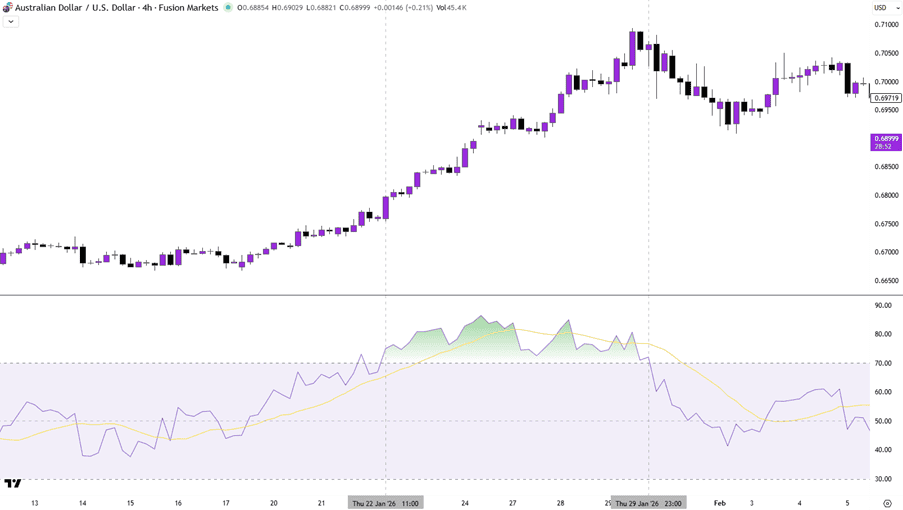
Figure 1 - AUDUSD 4-hour chart
As you can see between 22 Jan – 29 Jan, the RSI (with standard settings) signalled an ‘overbought’ condition for the bulk of the bullish move. Had you been waiting for a retracement due to AUDUSD being ‘overbought’, you would’ve missed a 4.3% move in the pair!
This is where a lot of traders run into trouble. Indicators like RSI or Stochastic are designed to measure the speed of a move, not its sustainability. When markets are trending, those indicators can stay elevated for long periods. Selling simply because something looks overbought can mean repeatedly fading a move that has no real reason to reverse.
The same applies on the downside. A currency can look deeply oversold, but if the underlying driver is still in place, there’s no requirement for it to bounce. In fact, the absence of a bounce can be a signal in itself – it tells you the market is still comfortable pressing in that direction.
Where the concept of overbought and oversold becomes more useful is in the context of conditions, not signals.
In quieter, range-bound markets, mean reversion tends to dominate. Price oscillates within a defined structure, and extremes are more likely to fade. In those environments, overbought and oversold readings can actually have some relevance – not because they predict reversals, but because they highlight when price is stretched relative to its recent range (Figure 2).
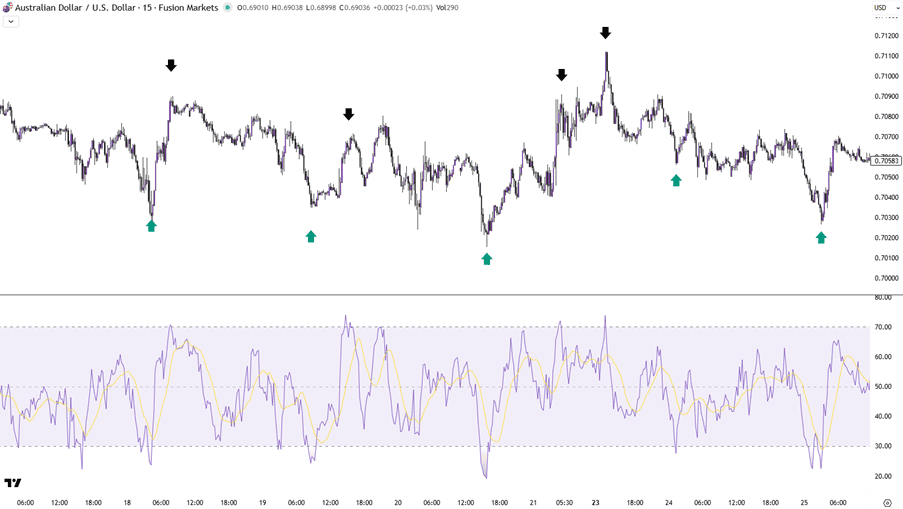
Figure 2 - AUDUSD 10-min chart showing RSI overbought and oversold
The key difference is that in a range, there’s no strong macro force pushing price beyond those boundaries. Without that underlying driver, moves tend to exhaust themselves more naturally.
Contrast that with a trending environment, and the behaviour shifts completely. Instead of reverting, price tends to consolidate briefly before continuing in the same direction. What looks like an “overbought” condition is often just a pause – not a turning point.
Another layer that’s often overlooked is positioning.
When a market becomes crowded, the risk of reversal increases – but not necessarily because it’s overbought. It’s because there are fewer new participants left to push the move further. If positioning starts to unwind, that’s when you can get sharp pullbacks, even within a broader trend.
But again, this isn’t about a level on an indicator. It’s about understanding who is in the trade, and whether there’s still fuel left in the move.
There’s also a behavioural aspect to all of this. The idea of overbought and oversold appeals because it offers a sense of control – a way to call turning points. But FX markets don’t reward that kind of thinking consistently. They reward alignment with the dominant driver, not attempts to pick the exact moment it ends.
That’s why you’ll often see the same pattern play out. Traders fade a move because it looks stretched, get stopped out as it continues, and then hesitate when the actual reversal finally comes.
So rather than treating overbought and oversold as triggers, it’s more useful to think of them as context.
If a market is trending strongly, an overbought reading might tell you momentum is healthy – not that it’s about to reverse. If a market is range-bound, the same reading might suggest price is nearing the edge of its structure. The indicator hasn’t changed, but the environment has.
And that’s really the point.
In FX, the meaning of any signal depends on the backdrop it’s sitting in. Overbought and oversold aren’t wrong – they’re just often misunderstood.
We’ll never share your email with third-parties. Opt-out anytime.
Relevant articles