

The Most Common Mistakes New Gold Traders Make

Read Time: 5-6 minutes
Gold is usually one of the first markets newer traders become interested in. It moves quickly, reacts dramatically to headlines, and tends to produce the kind of sharp rallies and selloffs that catch people’s attention immediately. Compared to slower-moving forex pairs, gold feels alive.
That’s also exactly why so many traders struggle with it early on.
A lot of beginners approach gold expecting fast profits because they’ve seen screenshots online of huge intraday moves or traders capturing massive gains from short-term volatility. What often gets left out is how unforgiving gold can be when conditions turn against you.
Unlike some markets that move gradually, gold can shift direction aggressively within minutes, particularly during busy trading sessions or around major economic data.
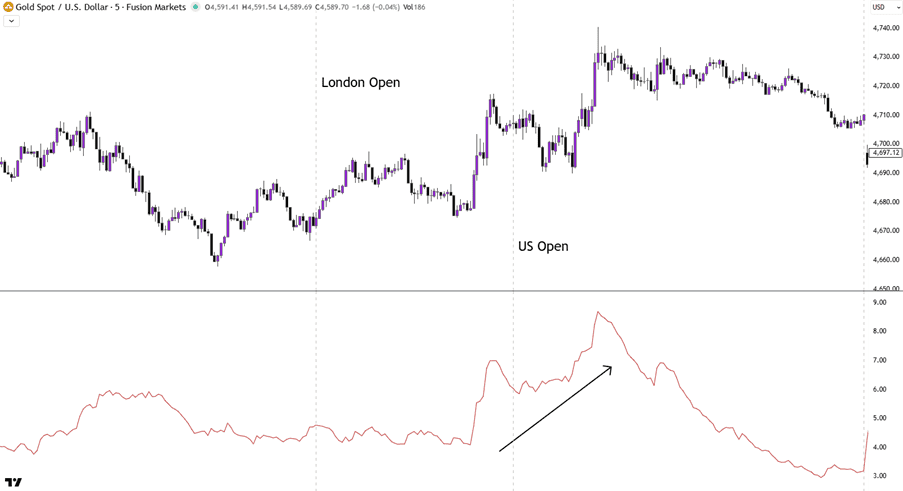
We can visualise the up-tick in trading activity by using the Average True Range indicator on the 5-minute XAUUSD chart.
One of the most common mistakes newer traders make is trading position sizes that are simply too large for the volatility they’re dealing with.
Gold doesn’t need much momentum to move several dollars in a very short period of time. That sounds great when the trade is working, but much less enjoyable when the market pulls back sharply before continuing in the original direction.
A lot of traders discover this the hard way. They risk too much; place stops too close to the market and get shaken out by completely normal price movement. Then they watch gold continue toward the level they originally expected after they’ve already been stopped out.
It’s frustrating, but extremely common.
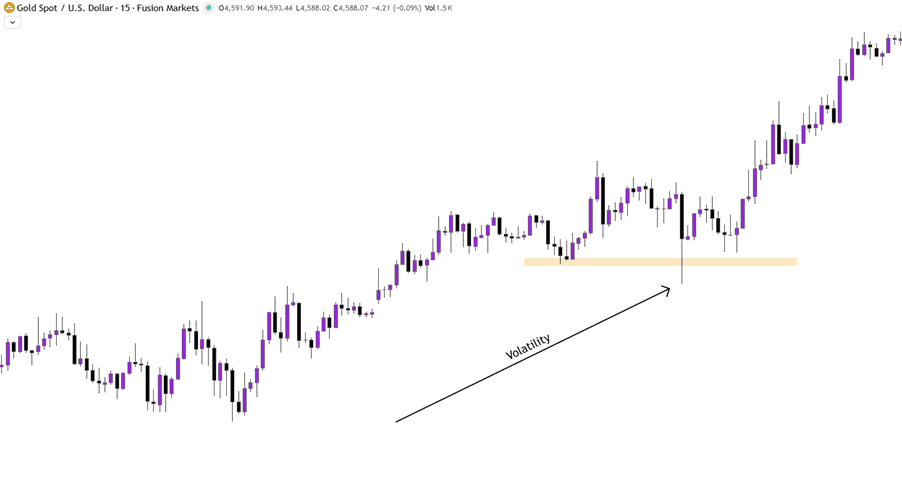
XAUUSD 15-min chart: Traders who had their stop too tight under the previous low would’ve been taken out by the volatility, only to watch price to continue the trend without them.
Another issue is trying to trade every single move.
Gold trades nearly around the clock, so there’s always something happening somewhere. Newer traders often feel pressure to constantly be involved, especially after seeing a move happen without them. Missing out on one rally can quickly lead to chasing the next one, usually at the worst possible time.
The reality is that gold behaves very differently depending on the time of day. Some sessions are active and directional, while others are slow and messy. Experienced traders understand this and tend to be selective about when they participate.
Many newer traders aren’t patient enough for that yet.
They sit through quiet periods forcing trades that probably shouldn’t be taken in the first place.
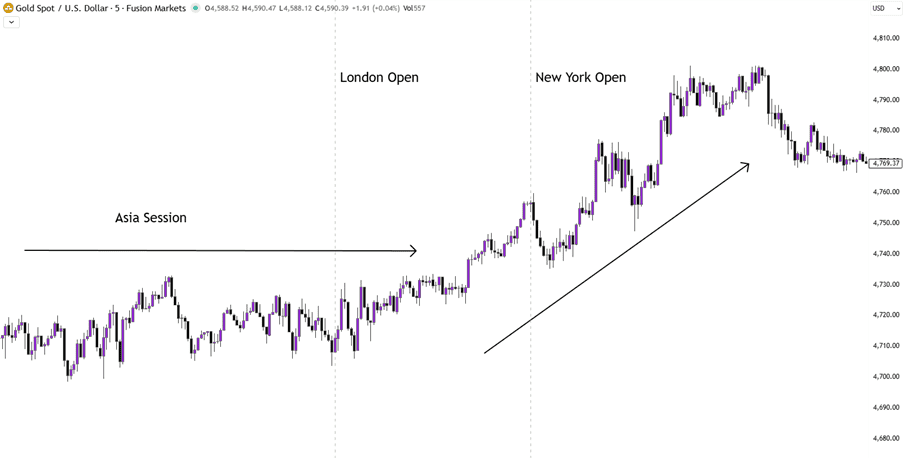
XAUUSD 5-min chart: low-liquidity, range-bound price action during the Asia session, before volatility picks up and an intraday trend is observed.
Trading during major economic releases causes problems too.
Gold reacts heavily to US inflation data, Federal Reserve comments, employment figures, and changes in bond yields. During those moments, price action can become extremely aggressive. Candles expand rapidly, spreads widen, and reversals happen fast enough to catch traders completely off guard.
A common beginner mindset is assuming the outcome should be obvious. Strong US data means gold falls. Weak data means gold rises. Simple.
Except markets rarely behave that neatly.
Sometimes gold rises alongside strong data because traders focus on inflation risks. Other times, weaker numbers barely help gold at all because the US dollar strengthens elsewhere. Traders who only focus on the headline often end up confused by the reaction.
The market’s interpretation matters more than the data itself.
Another mistake that shows up constantly is ignoring the bigger picture.
Some traders become so focused on tiny chart movements that they completely lose track of what’s actually driving the market. Gold isn’t just moving randomly from candle to candle. It’s constantly responding to interest rates, inflation expectations, risk sentiment, geopolitical uncertainty, and movements in the US dollar.
That doesn’t mean every gold trader needs a full macroeconomic model sitting beside them, but understanding the broader environment helps explain why certain setups suddenly fail or why momentum disappears without warning.
It’s surprisingly common to see traders buy gold simply because a pattern “looks bullish” while Treasury yields are surging higher and the US dollar is rallying aggressively at the same time.
Sometimes the chart alone doesn’t tell the full story.
Emotional decision-making is another major hurdle.
Gold has a way of pulling traders into emotional reactions because the moves can feel urgent. Sharp rallies create fear of missing out. Sudden drops trigger panic. Traders begin second-guessing themselves, moving stop losses further away, or closing trades far too early because they become nervous about giving profits back.
Most traders experience this at some point.
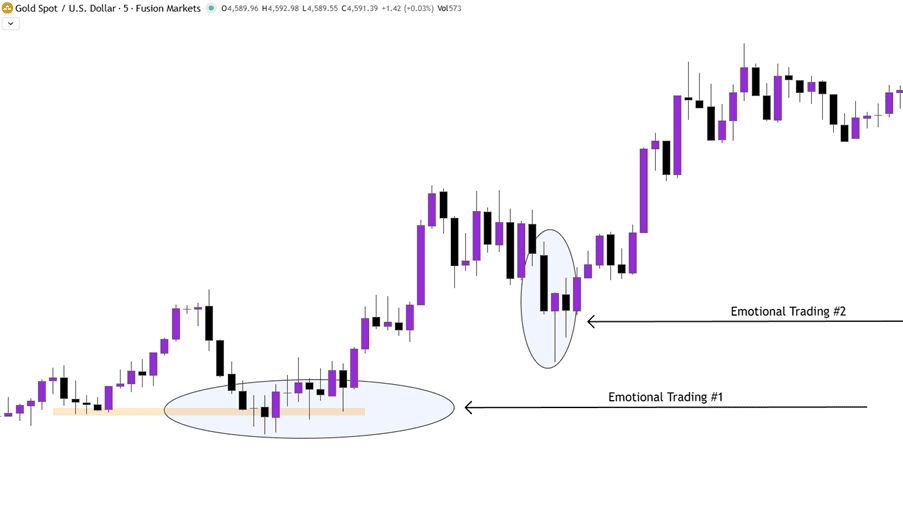
XAUUSD 5-min chart: Two examples of emotional trading. The first shows how traders may think the bullish move is over because price broke a previous low. The second, traders may have closed their positions after seeing a large bearish candle. In both situations, the trader would’ve been incorrect only to watch price continue to the upside.
The difficult part is that emotional decisions usually happen fastest during the exact moments traders should be staying calm.
One bad trade often leads to another. A trader gets stopped out, immediately jumps back into the market trying to recover the loss, and suddenly turns one manageable mistake into several. Gold moves quickly enough that frustration can snowball if discipline disappears.
This is one reason experienced traders often talk more about risk management than entries.
The goal isn’t to win every trade. That’s impossible. The goal is staying consistent long enough for good decisions to compound over time.
Newer traders sometimes underestimate how important survival actually is in trading. Gold will always provide opportunities tomorrow, next week, and next month. There’s no need to force trades or take oversized risks trying to make everything happen immediately.
Gold remains one of the most popular markets in the world for a reason. It’s liquid, volatile, and heavily influenced by global events, which creates opportunity for traders across almost every style.
But it’s also a market that tends to expose impatience very quickly.
For many traders, success in gold has less to do with finding the perfect strategy and more to do with avoiding the same avoidable mistakes over and over again.
We’ll never share your email with third-parties. Opt-out anytime.