

JPY Intervention:
Circuit Breaker Not Smoking Gun
Read Time: 5-6 minutes
FX intervention is back on the market’s radar after the Japanese Finance Ministry confirmed that they intervened in the FX market between April and May 2026.
They spent a total of $73 billion US Dollars in their intervention attempts to try and support the JPY.
However, the confirmation of course simply affirmed what traders already knew after the price action showed tell-tale intervention behavior.
On 30 April, the USDJPY pair fell close to 500 pips after the pair briefly pushed through the highly watched 160 area.
Then on the 5 May, we saw another attempt of close to 300 pips, which markets saw as a second attempt by the Finance Ministry to spook JPY bears.
This has triggered the usual market debate on whether Japanese officials have drawn a hard line in the sand at 160, and what the intervention means for the USDJPY going forward.
- What is FX intervention?
- It's not about a level
- Intervention is not a smoking gun
- Intervention is a circuit breaker
- Sneaky intervention
- Practical Takeaway
Currency intervention isn’t new and has happened by various governments or central banks.
It’s basically any direct attempt from a government or a central bank to influence the exchange rate.
In the case of Japan, the Bank of Japan are the ones that does the actual intervention, but they do so under the guide and instruction from the Finance Ministry.
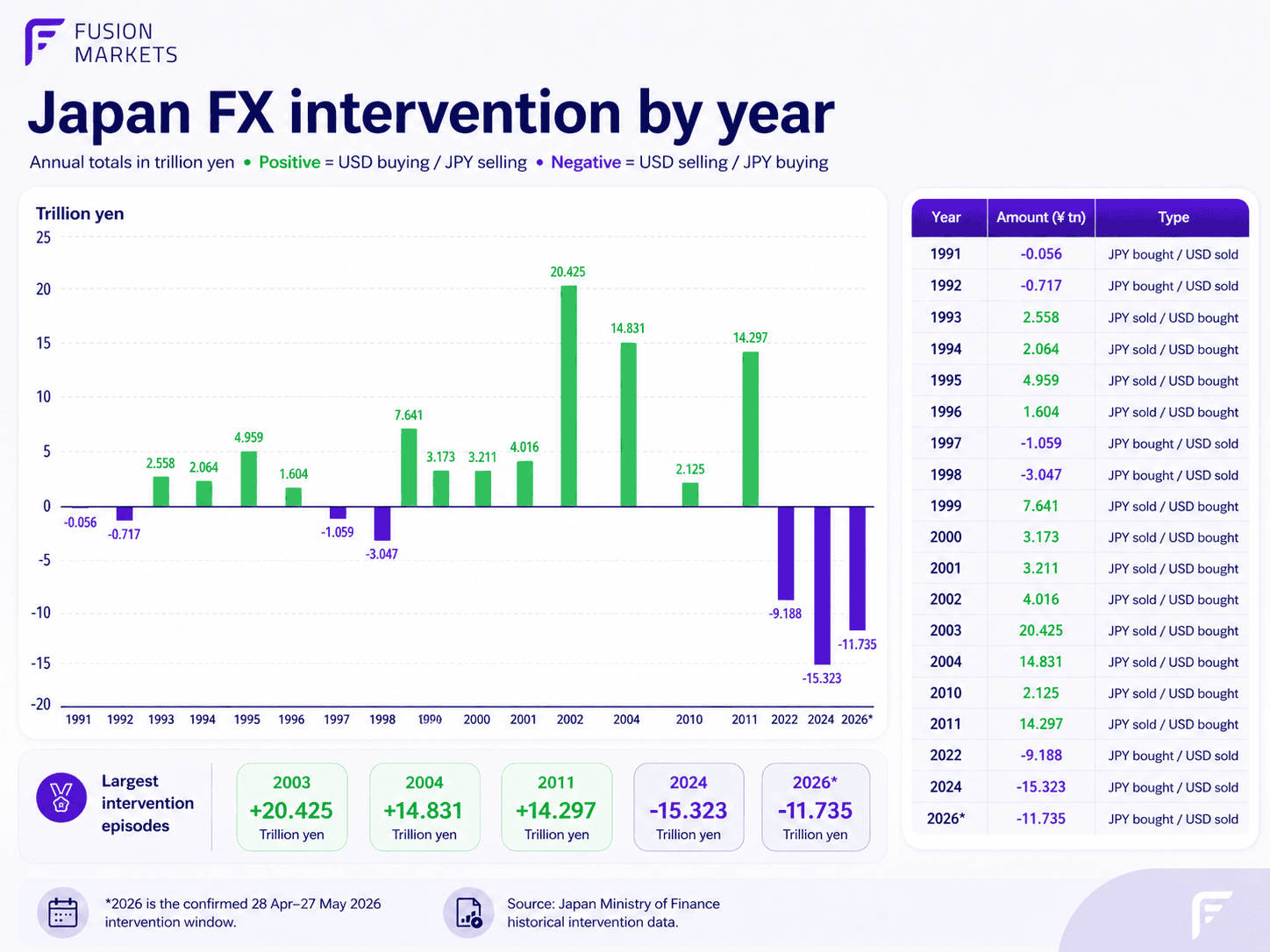
Now, even though the BoJ has in recent years intervened to try and support a weak JPY, there have also been occasions where they have tried to stop JPY strength as well.
So, if they want to support the JPY, they will sell US Dollars and buy the JPY.
And if they want to curb JPY strength, they will buy US Dollar and sell the JPY.
One of the biggest mistakes traders make is treating intervention as a fixed-price rule.
The media might be partially to blame for this, as they always overemphasize key levels where Japanese officials have previously intervened from.
Previous intervention levels can and do fold all the time.
Japanese officials are not only watching one price on a screen.
They are watching the speed of the move, the volatility, positioning, the impact on import prices, and the broader fundamentals.
That is why intervention is better understood as a response to disorderly market conditions, not just a fixed-price trigger.
A level may matter psychologically in the short-term, but if the macro pressure is strong enough, markets can push through any ‘line in the sand’ that traders shout about.
That’s why traders shouldn’t treat levels as hard ceilings, but it’s not an impenetrable wall.
It’s important to keep in mind that intervention does not always produce lasting moves in the USDJPY.
The times when FX intervention are most effective is when it lines up with a broader macro shift or driver.
The recent interventions in 2022 and 2024 are great examples.
In September 2022, Japan intervened to support the yen after USDJPY had surged on widening US-Japan rate differentials.
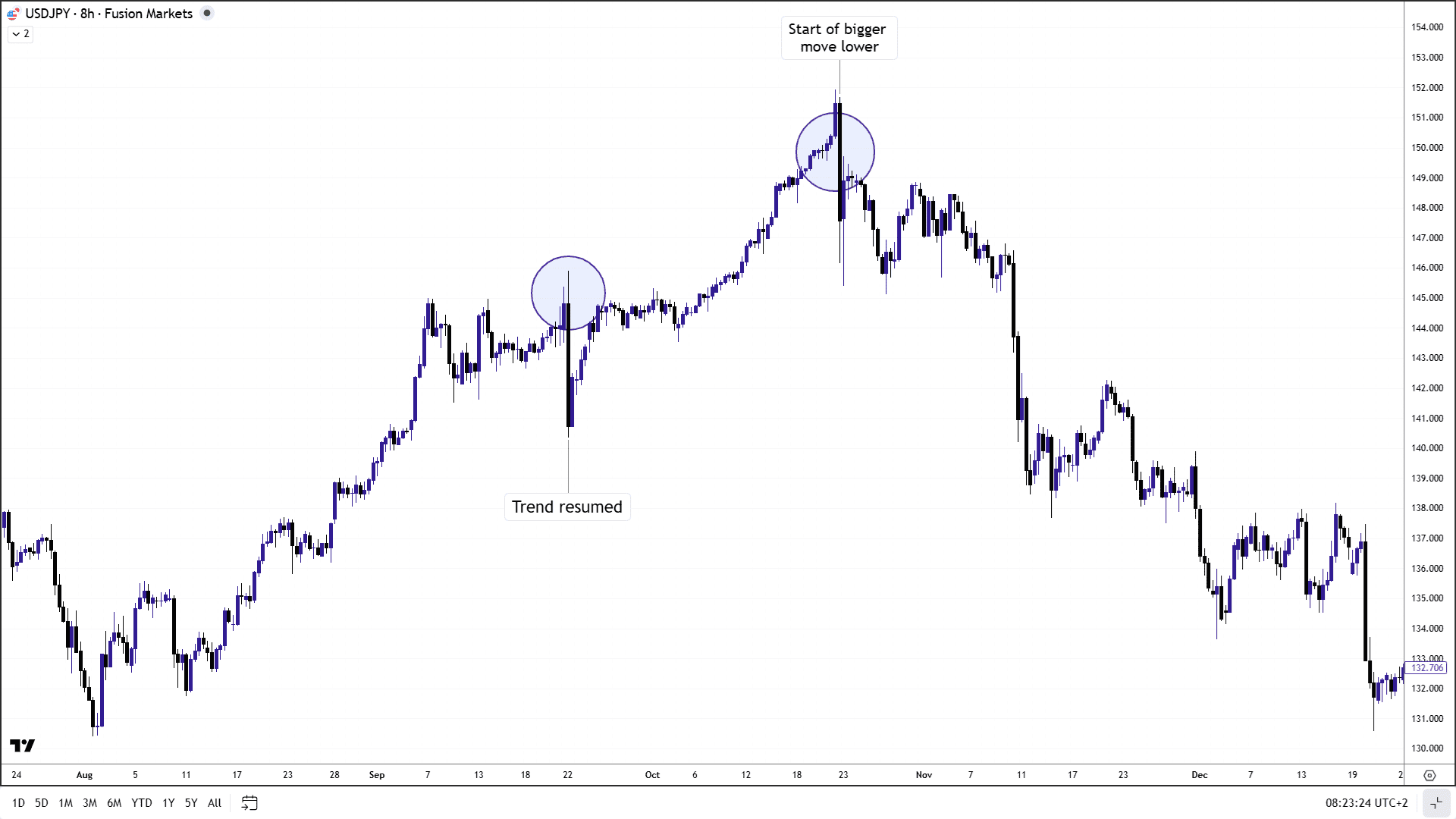
USDJPY dropped sharply at first, but the move did not last.
Even though the markets and the media touted 145.00 as the line in the sand, the pair made it all the way to 152.00 before Japanese officials intervened again.
That episode is important because it shows that intervention alone is not enough when the macro tide is still pushing the USDJPY higher.
Then in October 2022 the bank acted again, but this time it worked to shift the tide.
Now, it would be misleading to say intervention alone caused the reversal.
The follow-through lower had additional help, and that’s the point.
At the same time, we had softer US inflation data, lower US yields, shifting Fed expectations, and later adjustments from the BoJ around Yield Curve Control.
In other words, intervention worked better because the macro backdrop started to move in the same direction.
The exact same pattern showed up in 2024 as well.
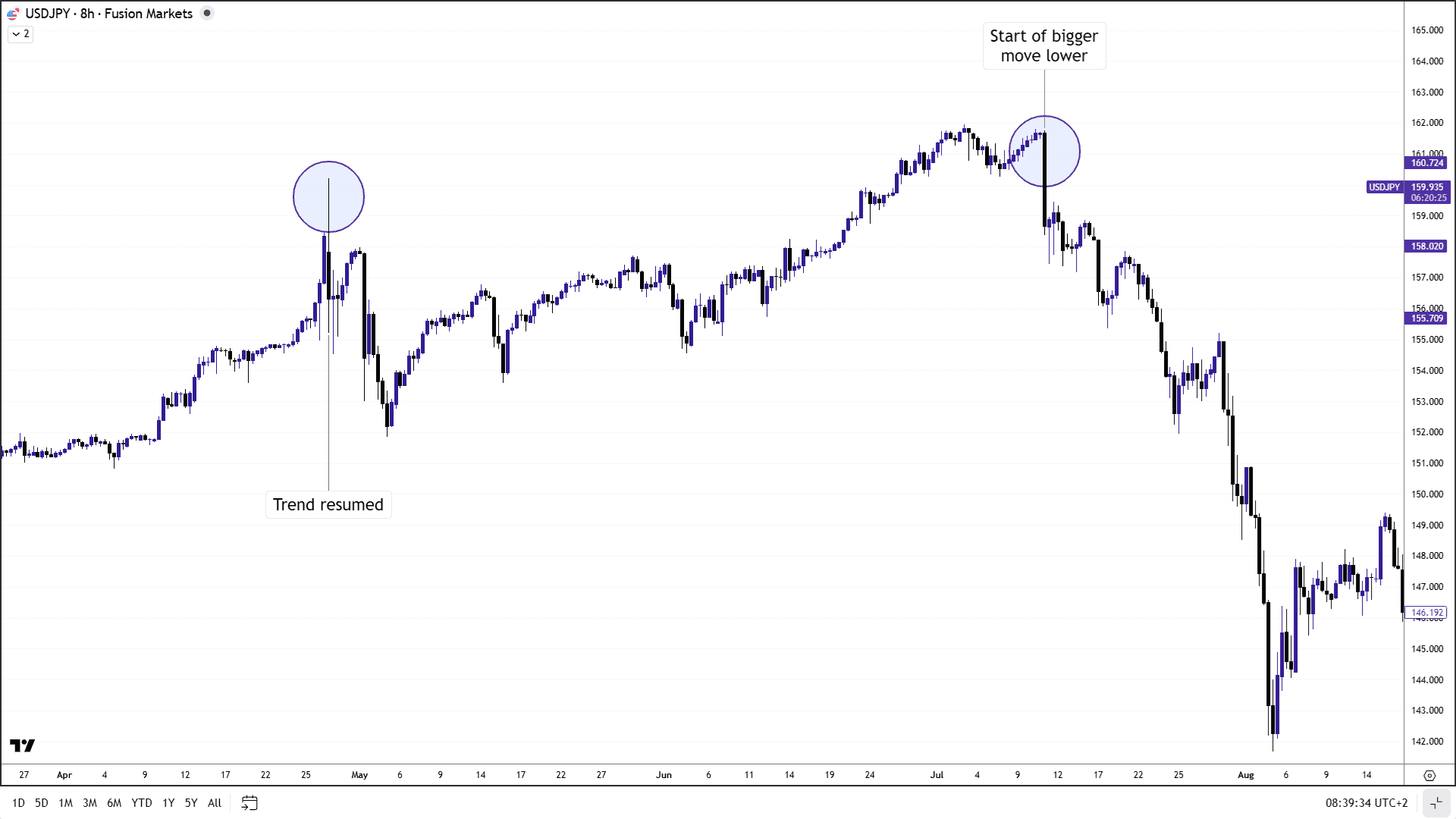
Japan intervened in April and early May 2024 after USDJPY moved through the 160.
Initially, the pair dropped sharply, but the effect faded and USDJPY later recovered.
Then in July 2024, intervention was followed by a more meaningful move lower. But again, that move had help from softer US data, expectations for Fed interest rate cuts, and a broader unwind in JPY carry trades.
So, the historical evidence shows that intervention doesn’t stop the USDJPY from going up, but it can help to accelerate a top if the macro backdrop is shifting.
The best way to think about intervention is as a circuit breaker, and not a trend changer.
A circuit breaker does not change the fundamental outlook.
Intervention can’t turn the JPY into a high-yielding currency or stop US yields from climbing.
It doesn’t change the market’s mind about interest rates in the US or magically change demand for dollars.
Intervention is there to break momentum and stop disorderly moves.
It forces short-term traders to cut exposure and trigger stop-losses.
The hope for intervention is that it makes traders think twice before chasing USDJPY higher or adding to longs.
In a way, it’s there to buy policymakers some time while they wait for the macro backdrop to become more supportive.
But a circuit breaker is not the same as a full trend reversal.
The trend changes when the underlying drivers change.
For USDJPY, those drivers are mainly US yields, Fed and BoJ policy expectations, US and JP real yields, global risk appetite, and carry trade positioning.
So, even though intervention can start a short-term flush, it’s the macro backdrop that decides whether the move continues.
One interesting nuance to keep in mind is that Japan can sometimes choose moments when the market is already vulnerable to intervene.
This has especially been true around US economic data releases.
In July 2024 the USDJPY initially dropped after a softer US CPI print.
The data was already negative for the dollar, and it pushed US yields lower and increased expectations that the Fed will need to cut rates.
Japanese officials used the dollar softness after the CPI data to intervene, basically adding official yen-buying and dollar-selling pressure on top of an already strong move.
So, instead of fighting a strong dollar impulse head-on, authorities can wait for a risk event that naturally weakens USDJPY and then step in to amplify the move.
Below is a quick pocket guide you can use for navigating intervention episodes and draining out the media noise.
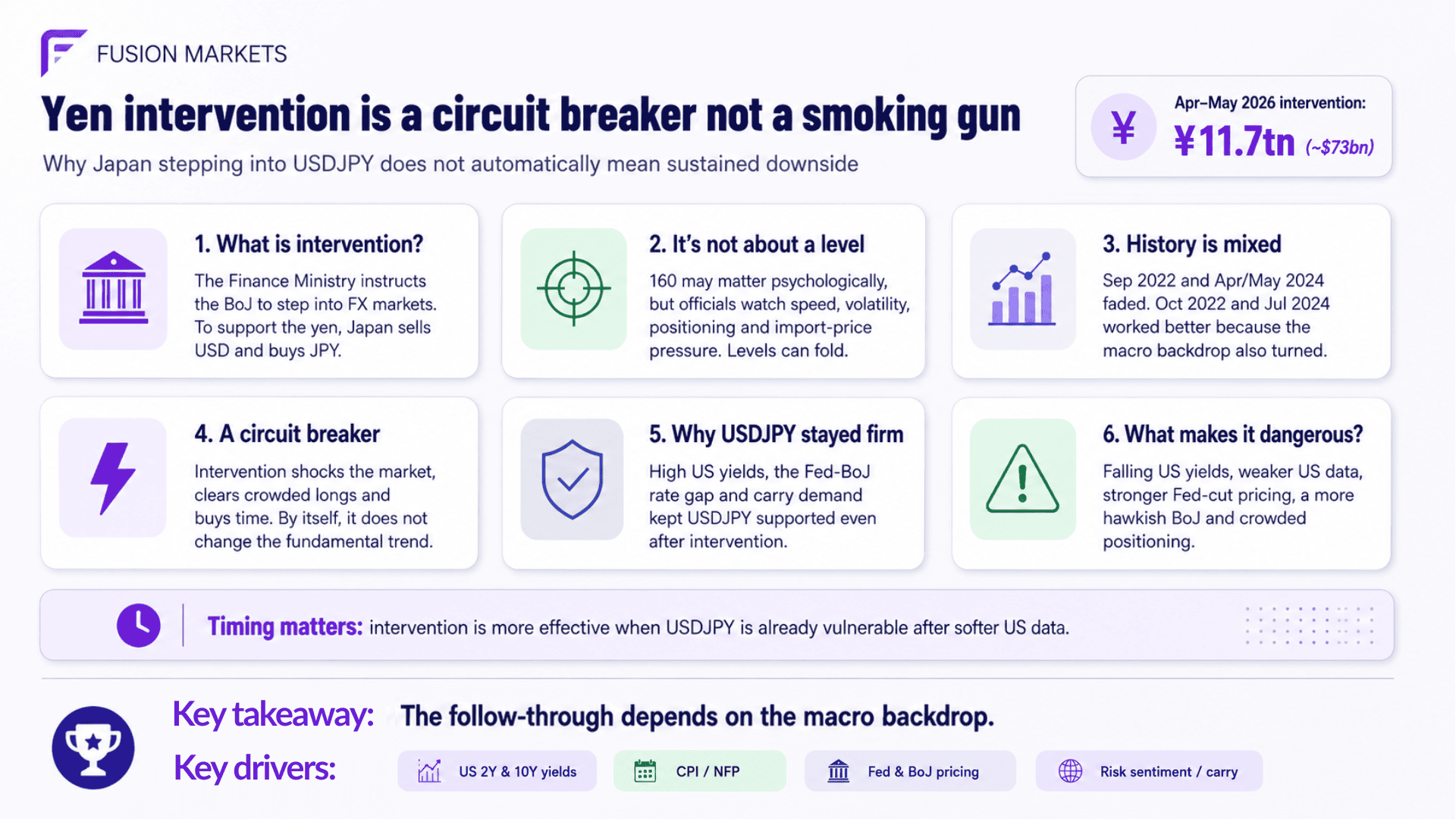
Don’t treat intervention as a binary signal.
Do not think because we had intervention that the USDJPY must go lower every time we reach previous intervention levels.
The follow-through matters more than the first drop.
A sharp fall after intervention tells us Japanese authorities are willing to act. But the next phase tells us whether the macro backdrop support follow through or not.
If USDJPY drops on intervention, but yields and dollar fundamentals still suggest upside, the more likely outcome is a slow grind higher.
If USDJPY drops on intervention, while US yields are falling and dollar fundamentals are weakening, the more likely outcome could be the start of a bigger more sustainable move lower.
For traders, the key variables or drivers to watch for the USDJPY are:
- US 10-year and 2-year Treasury yields
- Fed and BoJ rate expectations
- Big tier 1 economic data from the US (CPI and NFP)
- Risk sentiment and carry-trade positioning
The bottom line is that intervention is not a smoking gun for traders to turn bearish on the USDJPY.
Just because we are trading close to prior intervention levels, don’t assume that it happens again.
Prior levels are helpful areas to watch, but these levels can and often do fold.
Intervention is there to scare speculators and punish crowded positioning, but it does not automatically change the trend.
We’ll never share your email with third-parties. Opt-out anytime.