

The Difference Between a Trading Setup and a Trading Signal

Read Time: 5 minutes
One of the easiest traps in trading is thinking that every interesting thing on a chart is a trade.
A candle breaks above resistance. A moving average crosses. Price taps a level that worked last week. An indicator flashes green. It feels like something is happening, and for a lot of newer traders, that is enough to hit the button.
But there is a big difference between a trading setup and a trading signal. Understanding that difference can make a trader far more selective, and often far less reactive.
A trading setup is the broader situation. It is the reason a trader is interested in the market in the first place. A trading signal is the specific trigger that tells the trader it may be time to act.
In other words, the setup is the context. The signal is the timing.
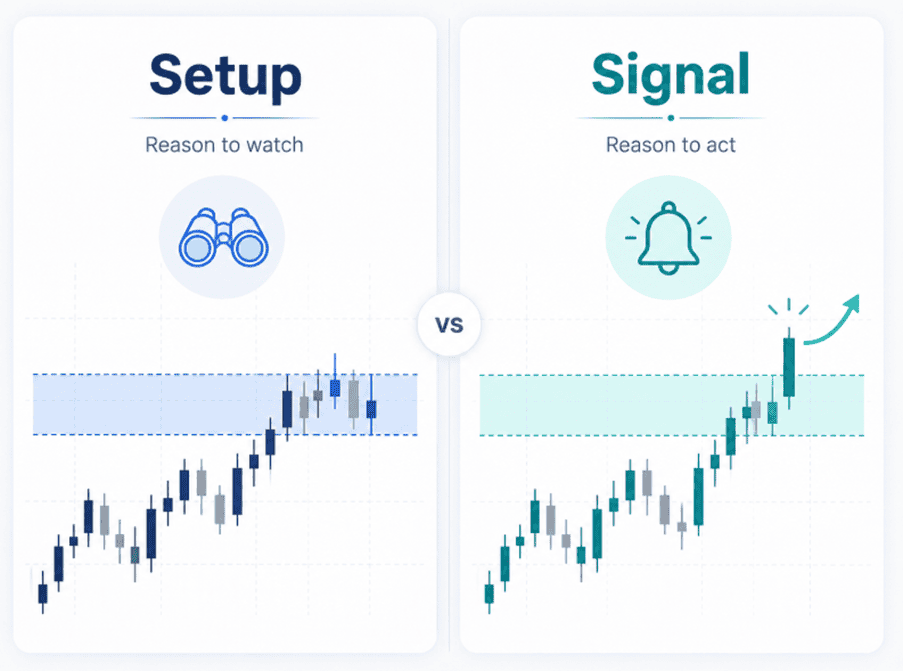
Think of it like this; if a trader is watching AUDUSD because price has pulled back into a major support area on the four-hour chart, that is a setup. It is a zone of interest. It tells the trader, “This is worth watching.” But it does not automatically mean they should buy.
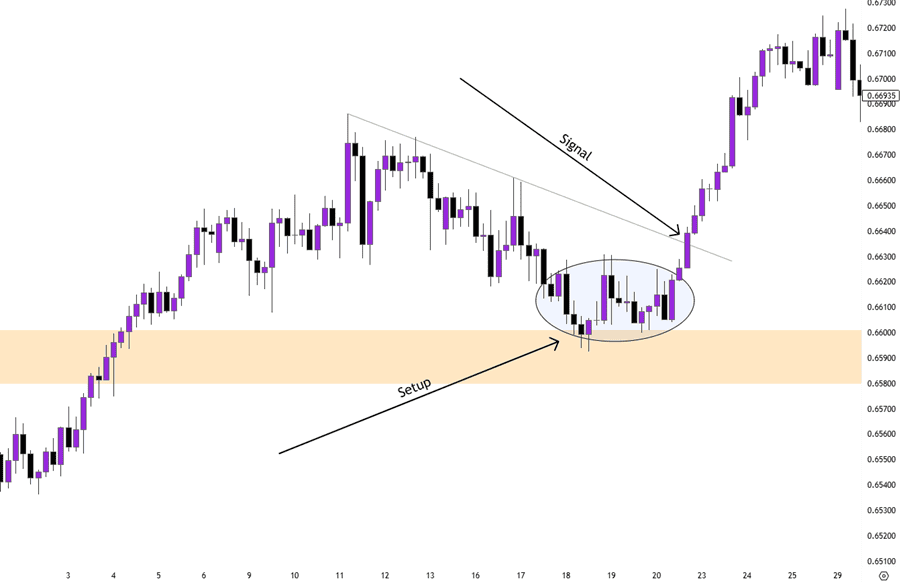
Chart 1 – AUDUSD 4-hour chart. An example of a long setup vs a long signal.
The signal might come later. Perhaps price rejects the support level with a strong bullish candle. Maybe it breaks a short-term trendline. Maybe the trader waits for a higher low on a lower timeframe. Whatever the method, the signal is the moment that turns an idea into a possible trade.
This distinction matters because many traders enter too early. They see a setup forming and treat it as if the signal has already arrived. The level looks good, the idea makes sense, and they do not want to miss it. So they enter before the market has shown any real sign of turning.
Sometimes that works. More often, it leads to frustration. Price drifts through the level, chops sideways, or stops them out before eventually doing what they originally expected. The trade idea may not have been bad. The problem was timing.
A setup without a signal is not a trade. It is just a market to watch.
This is especially important in forex, where pairs can sit around key levels for hours or even days. A currency pair may be near support, but that does not mean buyers are ready to step in. It may be near resistance, but that does not mean sellers are about to take control. Markets can pause, fake out, reverse, continue, or simply do nothing for longer than traders expect.
A good setup gives a trader a reason to pay attention. A good signal gives them a reason to participate.
For example, a trend following trader might identify an uptrend on the daily chart (higher highs, higher lows), and current price holding above a key moving average may all suggest the broader direction is still positive. That is the setup.
The signal might be a pullback into a support zone followed by a bullish rejection candle, or a break above a minor consolidation pattern. Without that trigger, the trader is simply watching a trend. With the trigger, they have a possible entry.
A breakout trader may work in a similar way. The setup could be a long period of consolidation, where price has been trapped in a narrow range. That tells the trader pressure may be building. But the signal is not the range itself. The signal may be a clean break beyond the range high or low, a close outside the range, or a retest that holds after the breakout.
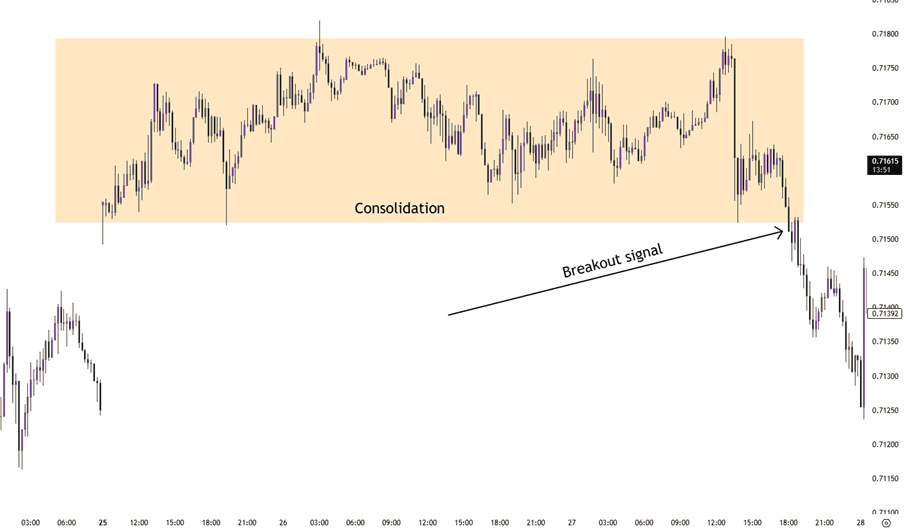
Chart 2 – AUDUSD 15-min chart. A good example of a consolidation setup, followed by a breakout signal.
This is where patience as a trader becomes extremely important. Many traders know what a good setup looks like… but they struggle to wait for the signal. They want to be early. They want the best price. They want to catch the move before everyone else sees it.
The problem is that being early can be just another way of being wrong.
Waiting for a signal does not guarantee a winning trade. Nothing does. But it can stop traders from entering purely because they feel something should happen. It gives the trade a clear starting point, and just as importantly, a clearer invalidation point. If the signal fails, the trader knows why they are wrong.
That is another key benefit of separating setups from signals. It can improve risk management. When a trader enters based on a vague feeling, it is often hard to know where the stop-loss should go. But when the trade is based on a defined signal, the risk can usually be planned more cleanly.
For instance, if the signal is a bullish rejection from support, the stop may sit below the rejection low. If the signal is a breakout from a range, the invalidation point may be back inside the range. The trader is no longer guessing. They are building the trade around a specific event.
This also helps with reviewing trades later. If a trade loses money, the trader can ask better questions. Was the setup actually strong? Was the signal clear? Did I enter before my rules were met? Did I follow the plan, or did I force the trade?
Those questions are more useful than simply asking, “Why did I lose?”
A setup and a signal work best together. A signal without a setup can be random noise. A setup without a signal can lead to premature entries. But when the broader context and the timing trigger line up, the trade has a clearer structure.
That does not mean traders need a complicated system. In fact, simple can be better. A setup might be as basic as price pulling back in an uptrend. A signal might be as simple as a bullish candle closing from a support area. The important thing is that the trader knows which part is the idea and which part is the trigger.
For newer, less experienced traders, this can be a useful method of slowing things down. Before entering the trade, ask yourself two questions:
- What is the setup, and;
- What is the signal?
If the answer to either one is unclear, it may not be a viable trade yet.
Forex trading already has enough uncertainty with the many fundamental factors impacting price. Distinguishing setups from signals will not remove that uncertainty, but it can make the decision-making process cleaner. It helps traders stop reacting to every flicker on the chart and start waiting for situations that actually match their plan.
Sometimes the market is giving you a setup. Sometimes it is giving you a signal. The skill is knowing the difference.
We’ll never share your email with third-parties. Opt-out anytime.