

Why Forex Traders Should Pay Attention to the US Dollar Index
Read Time: 4-5 minutes
It is easy to get tunnel vision in forex.
A trader might spend all morning staring at EURUSD, trying to work out whether the next move is a breakout, a fake-out, or just another messy bit of price action before London properly gets going. Someone else might be watching AUDUSD, convinced the Aussie is about to turn because it has held the same support level three times.
That is all part of trading. You have to know the pair in front of you. But sometimes the thing driving the move is not the euro, the Aussie, the pound, or the yen. Sometimes it is just the US dollar.
That is where the US Dollar Index becomes a very useful tool for traders.
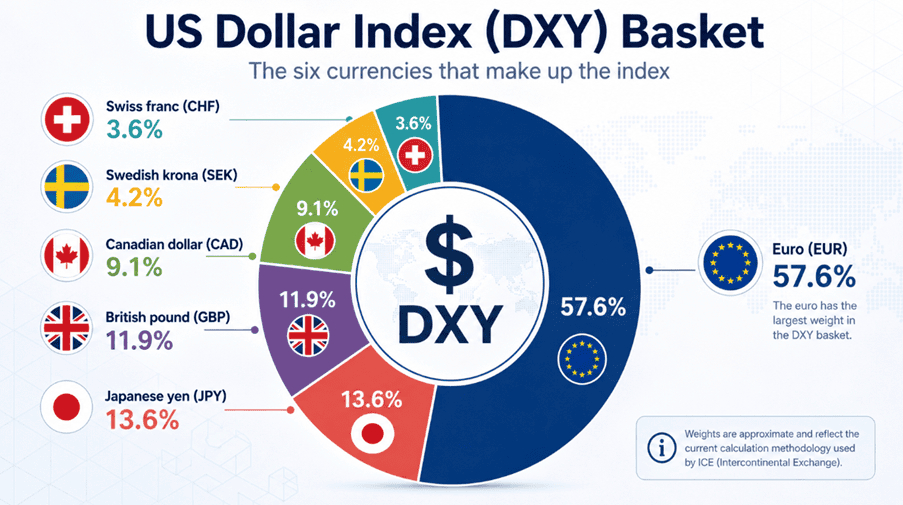
The DXY tracks the US dollar against a basket of major currencies, giving traders a quick way to observe whether the dollar is broadly strengthening or weakening – rather than relying on one currency pair alone. Like all things markets, it’s not perfect, and it should not be treated as a trading system by itself, but as a background check, it can be extremely useful.
The simple reason is that the US dollar influences so many major currency pairs; EURUSD, GBPUSD, AUDUSD, NZDUSD, USDJPY, USDCHF, and USD/CAD all have the dollar on one side of the trade. So, when the dollar is moving strongly across the board, it can have a direct impact on nearly every major FX pair a trader is watching.
This is one of the biggest reasons traders should keep an eye on the Dollar Index. It helps separate what is happening in a single currency from what is happening in the US dollar more broadly.
Take EURUSD as an example. If EURUSD is falling, it is tempting to say, “the euro is weak.” Sometimes that will be true. Maybe European data has disappointed, or the market is pricing in a more dovish European Central Bank. But if the DXY is also pushing higher at the same time, the bigger story may actually be around US dollar strength.
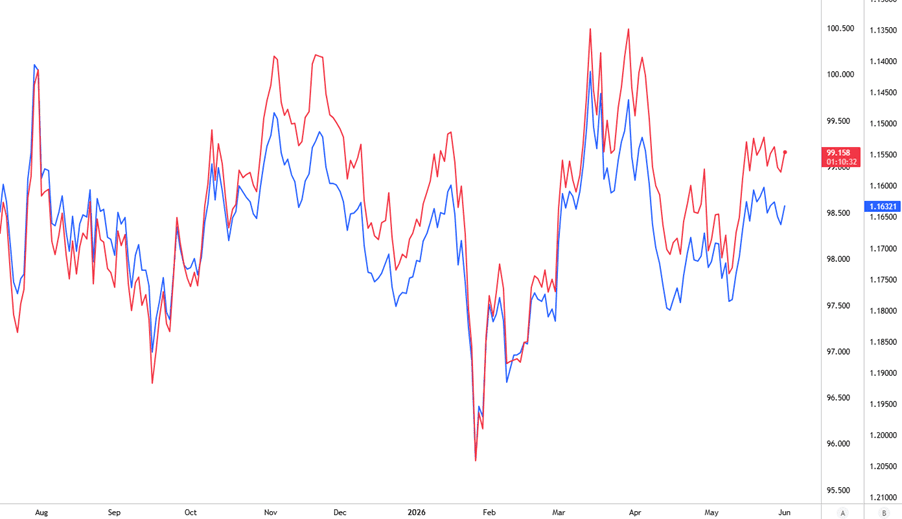
Chart 1 – DXY (red) vs EURUSD inverted (blue)
That distinction matters. A euro-specific decline and a broad dollar rally are not quite the same thing. They might look similar on the EURUSD chart, but the reason behind the move is different. And if the reason is different, the way a trader manages the trade may also be different.
This also applies to AUDUSD or NZDUSD. If they’re falling while the DXY is breaking higher, the move may have less to do with Australia or New Zealand and more to do with a stronger US dollar. However, if AUDUSD is falling while the DXY is flat, then the weakness may be coming from the Australian dollar itself. That distinction could point traders towards other drivers, such as commodity prices, China sentiment, local rate expectations, or broader risk appetite – all of which may affect the way a trader approaches a trade.
This is why the DXY works well as a confirmation tool.
Imagine a trader is looking for a long setup in GBPUSD. The pound has held support, price is starting to turn higher, and the chart looks constructive. If the DXY is also rolling over, that adds some weight to the idea. It suggests the move is not only about sterling strength, but also about a softer US dollar backdrop.
On the other hand, if GBPUSD is trying to rally while the DXY is also climbing, the setup becomes less clean. It does not automatically mean the trade is wrong. Markets can move for all sorts of reasons. But it does tell the trader they may be leaning against broader dollar strength, which is worth knowing before entering the trade.
The Dollar Index is also helpful around major US economic events. Inflation data, jobs numbers, retail sales, Federal Reserve meetings and bond yield moves can all shift the dollar quickly. After a big data release, it is useful to look at the DXY and ask: did the dollar move against everything, or is this just one pair reacting to its own story?
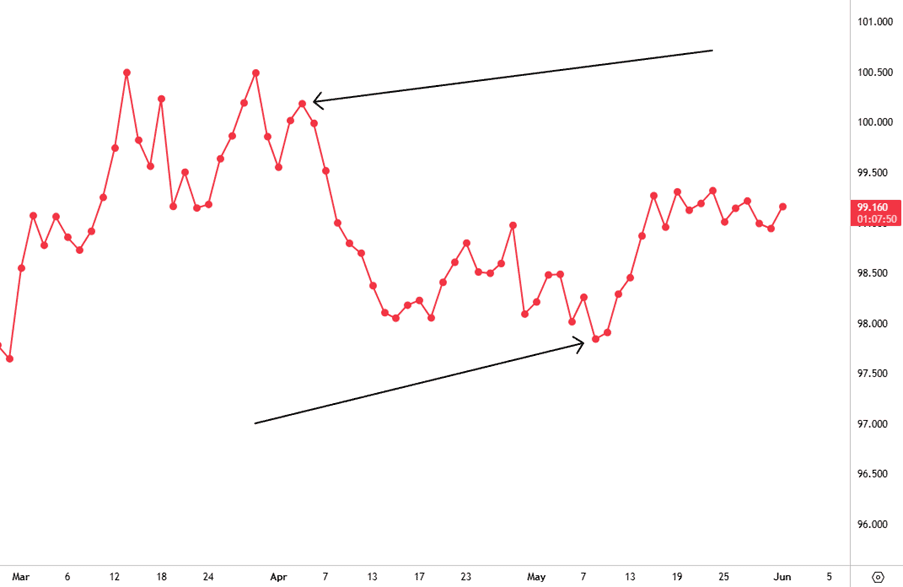
Chart 2 – DXY (red) vs two previous NFP releases (arrows)
That question can stop traders from misreading the market. A sharp move in one pair may look important, but if the broader dollar has barely moved, the signal may not be as strong as it first appears. By contrast, if the DXY breaks sharply higher or lower after the same event, it suggests the market is making a broader judgement on the dollar.
Of course, the DXY has its flaws. One of the main ones is that it is heavily influenced by the euro. Because of that, it can sometimes behave like an inverted EURUSD chart. Traders should keep that in mind, especially if they are trading pairs such as AUDUSD, NZDUSD or USDCAD, where other factors can matter just as much.
For commodity currencies, the DXY is only part of the picture. Risk sentiment, commodity prices, Chinese growth expectations and local central bank outlooks are just some of the things that play a role. A declining US Dollar Index (DXY) may help AUDUSD or NZDUSD, but it does not guarantee those currencies will rally if the local backdrop is weak.
That is the key point. The Dollar Index is not there to replace analysis. It is there to add context.
For many traders, that context can make the chart in front of them easier to read. If a USD pair is moving in line with the DXY, the trade may have broader market support. If the pair is moving against the DXY, there may be a stronger local driver at work. Either way, the trader has more information than they would have from looking at the pair alone.
Forex is never as simple as “the dollar is up” or “the dollar is down”. But the dollar is often the first place traders should look when a major pair starts moving.
The DXY will not predict every turn. It will not tell traders where to put their stop-loss, how much to risk, or whether a setup is worth taking. But it can help answer one of the most important questions in currency trading: is this move really about the pair I am watching, or is it about the US dollar?
That alone makes it worth paying attention to.
We’ll never share your email with third-parties. Opt-out anytime.