

How Much Money Do You Need to Start Trading?

Read Time: 3-4 minutes
If you’ve ever looked into trading, chances are this question’s crossed your mind pretty early on:
“How much money do I actually need to get started?”
Most people assume there’s a neat, straightforward answer – some fixed minimum balance that opens the door to the markets. But it rarely works like that in practice.
The number itself matters less than the situation around it. How you plan to trade, what you’re hoping to achieve, and how much financial (and emotional) pressure you’re willing to carry all play a role.
These days, the barrier to entry is lower than it’s ever been. Online platforms, mobile trading apps, and flexible contract sizing mean you can open a live account with a relatively small deposit. In practical terms, many traders begin somewhere between a few hundred and a few thousand dollars.
But there’s an important distinction between being able to start… and being set up to trade properly.
Starting with a very small balance – say a few hundred dollars – can absolutely serve a purpose. It lets you experience live market conditions, understand order execution, and get familiar with platform mechanics in a way demo accounts can’t fully replicate. There’s real emotion involved when real money is on the line, even in small amounts.
The trade-off, though, is flexibility.
With limited capital, position sizing becomes tight. You may find yourself forced into trades that don’t quite fit your strategy simply because margin requirements leave little room to manoeuvre. Returns, even when you trade well, can feel underwhelming in dollar terms, which sometimes nudges traders toward over-leveraging in an attempt to speed things up.
That’s where problems tend to begin.
For traders looking to approach the markets with a bit more structure, a starting balance closer to the $1,000 to $5,000 range often provides more breathing room. It allows you to risk sensibly per trade, hold positions without feeling squeezed by margin, and track performance in a way that actually reflects your decision-making – not just your account limitations.
It also reduces the temptation to take oversized risk, which is one of the quickest ways new traders derail themselves early on.
Of course, the “right” starting amount also depends heavily on what and how you trade.
If you’re drawn to short-term trading – scalping or intraday strategies – you’ll typically need a bit more capital to operate comfortably. Short-term trading involves tighter stops, more frequent entries, and exposure to transaction costs, all of which require adequate funding to absorb normal drawdowns.
Swing traders, on the other hand, can often function with slightly smaller balances. Because trades are held longer and stops are wider, there’s less need for constant margin availability. Position traders – those holding for weeks or months – may require larger capital again, particularly if they’re building multi-position portfolios.
So there’s no universal figure. The key is alignment: your capital should match your strategy, not fight against it.
What matters far more than your starting balance, though, is how you manage risk.
A trader with $2,000 risking 1% per trade is operating far more sustainably than someone with $20,000 risking 10%. Longevity in trading comes from survival through losing streaks – and those streaks happen to everyone, regardless of skill level.
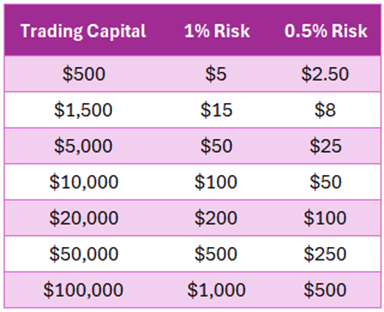
Position sizing, stop placement, and emotional control will always have more impact on your outcome than the number sitting in your account on day one.
There’s also a psychological layer that often gets overlooked.
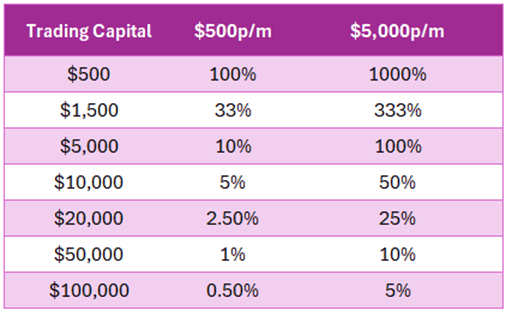
Starting too small can make trading feel trivial – or frustrating. Starting too small can make trading feel almost… weightless. When the dollar outcomes are tiny, it’s easy to lose focus or treat decisions casually because the stakes don’t feel real. To avoid this, it’s best to think of your trading in terms of a percentage, rather than dollar value. As shown in the table below, you can see that the smaller the account is, the bigger the monthly profit percentage needs to be. For example, to make $5,000 per month on a $1,500 account, you would need to return 333% per month – which is a very unrealistic goal.
Go too far the other way, though, and the pressure ramps up fast. Every fluctuation starts to feel personal. Instead of following a plan, you find yourself reacting to P&L swings – which usually leads to rushed entries, early exits, and second-guessing.
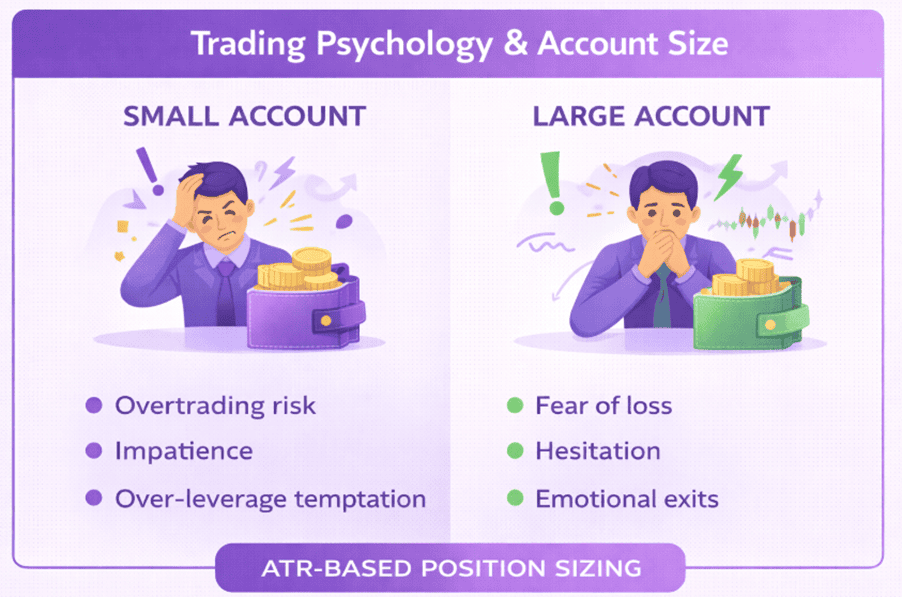
For most traders, the sweet spot sits somewhere in between. Enough capital that you take the process seriously, but not so much that normal drawdowns affect your day-to-day life or decision-making.
And it’s worth keeping perspective here – your first deposit isn’t some permanent benchmark. It’s just your starting point, not a definition of how far you can go.
Many traders start modestly, focus on consistency, and scale over time – either by compounding profits, adding funds gradually, or eventually accessing external capital. Growth becomes a by-product of process, not something forced through oversized risk.
So when it comes back to the original question – how much do you need to start trading – the honest answer is this:
Enough to manage risk properly. Enough to trade without financial stress. And enough to stay in the game while you build skill.
Because in trading, staying power matters far more than starting size.
We’ll never share your email with third-parties. Opt-out anytime.
Relevant articles