

How to Structure a Trading Plan That Actually Survives Volatility

Read Time: 3-4 minutes
Volatility is where most trading plans fall apart. And, given recent geopolitical events in 2025 and 2026, we thought it’s only appropriate to discuss how to structure a trading plan that actually survives volatility.
Not because the strategy stops working – but because the trader stops following it.
A trading plan written in calm conditions often assumes orderly markets, predictable pullbacks and neat technical patterns. But markets don’t stay calm. They spike, gap, overshoot levels and ignore indicators. If your plan only works when conditions are comfortable, it isn’t a plan – it’s a fair-weather outline.
So how do you structure a trading plan that actually survives volatility?
Start with risk, not entries.
Most traders obsess over finding the perfect setup. Professionals obsess over what happens if they’re wrong. A volatility-proof plan begins by defining maximum risk per trade and maximum risk per day or week. If you normally risk 1% per trade, your plan should state clearly whether that changes during high-volatility periods. Some traders reduce size when ATR expands; others keep risk constant but widen stops accordingly. The key is that the rule is written before the volatility arrives.
Your position sizing framework needs to be adaptive. Volatility expands and contracts constantly. If you use fixed pip stops regardless of conditions, you will either get stopped out repeatedly in fast markets or take oversized risk in slow ones. Using a volatility measure such as ATR to determine stop distance – and then calculating lot size from that stop – keeps your dollar risk stable even when price behaviour changes.
For example, in Figure 1 below, we’ve mapped out two 20-pip ranges on the EURUSD 1-hour chart, marked by blue boxes. During the low-volatility period, multiple hourly candles traded comfortably within that 20-pip band. In other words, a fixed 20-pip stop would have allowed the position room to breathe. However, once volatility expanded, the market failed to print a single hourly candle contained within 20 pips for several hours following the breakout. The stop distance that once represented meaningful protection was now sitting inside normal price movement.
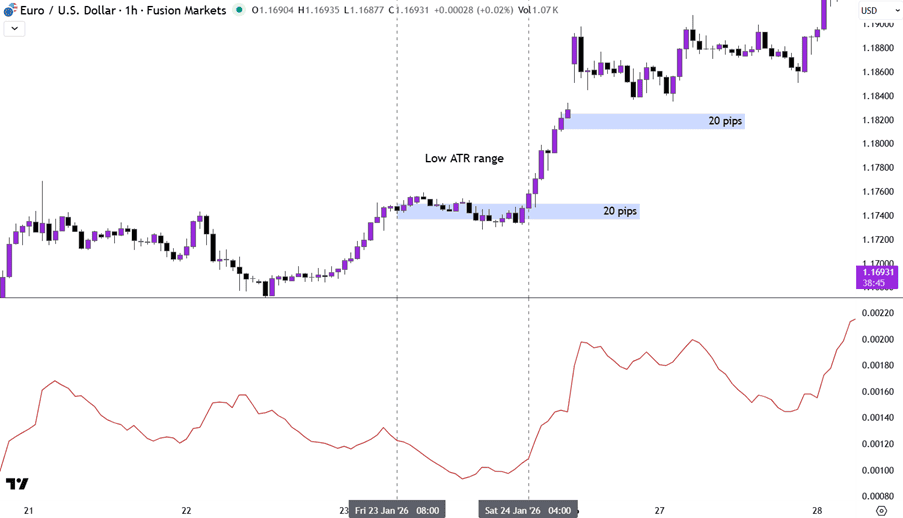
Figure 1: EURUSD 1-hour chart and Average True Range (ATR) (red).
Next, define your conditions for participation.
A robust trading plan clearly outlines when not to trade. High-impact economic releases, unexpected geopolitical developments, and illiquid holiday sessions can all distort price action. Decide in advance whether you trade through major data events or stand aside. If you do trade them, define the rules – for example, no new positions within 15 minutes of release, or spreads must remain below a certain threshold.
Volatility doesn’t just create opportunity; it increases execution risk. Slippage widens, spreads expand and emotions intensify. Your plan should acknowledge these realities rather than pretend they don’t exist.
Pre-define trade management rules.
This is where many plans quietly collapse. Traders enter with structure but manage with emotion. In volatile conditions, hesitation becomes expensive. Your plan should specify how stops are trailed, whether partial profits are taken, and under what circumstances a trade is closed early.
For example:
• Move stop to breakeven after 1R
• Trail behind structure, not candles
• Exit fully if market structure shifts on the higher timeframe
When the rules are written, you don’t have to think in the moment. You simply execute.
Build in drawdown tolerance.
Volatility increases variance. Even strong strategies will experience clusters of losses. Your plan should include an acceptable drawdown threshold and what action is taken if it’s breached. Do you reduce size? Pause trading? Review performance metrics?
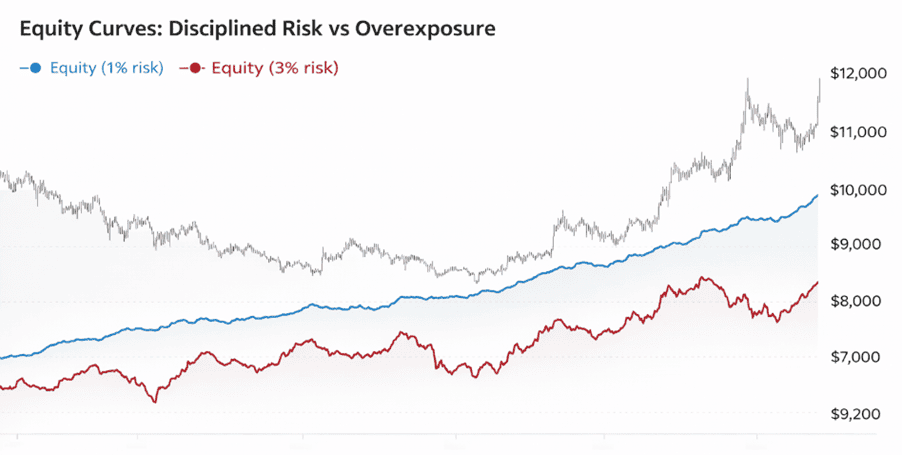
Figure 2: demonstration of how a consistent framework tends to preserve survivability even when outcomes cluster.
Figure 2 illustrates how two identical strategies behave under different risk frameworks. When position sizing increases from 1% to 3% per trade, equity swings become materially larger. During volatile phases, higher exposure amplifies both gains and drawdowns. Over time, this can compromise survivability. The edge itself hasn’t changed – only the risk per trade has.
Without a defined response, drawdowns trigger impulsive decisions – doubling down, abandoning systems, revenge trading. With a defined response, they become part of the process.
Include scenario planning.
A plan that survives volatility anticipates multiple outcomes. Before entering a trade, outline at least two alternate scenarios. What if price spikes through your level and reverses? What if it grinds sideways for hours? What if spreads widen significantly?
Writing these possibilities down reduces emotional shock when they occur. Markets are less intimidating when you’ve already rehearsed their behaviour.
Finally, keep the structure simple.
Complex systems are fragile. The more filters, confirmations and conditions you require, the more likely you are to freeze during fast markets. A volatility-resistant plan is clear, mechanical and repeatable. Entry criteria. Risk framework. Management rules. Exit rules. Review process.
That’s it.
Volatility is not the enemy of traders. It is the environment in which opportunity exists. But only structured traders benefit from it. The rest react to it.
If your plan can withstand rapid moves, wider spreads and emotional pressure, you don’t need calm markets to succeed. You simply need consistency.
And consistency is what turns volatility from threat into edge.
We’ll never share your email with third-parties. Opt-out anytime.
Relevant articles